
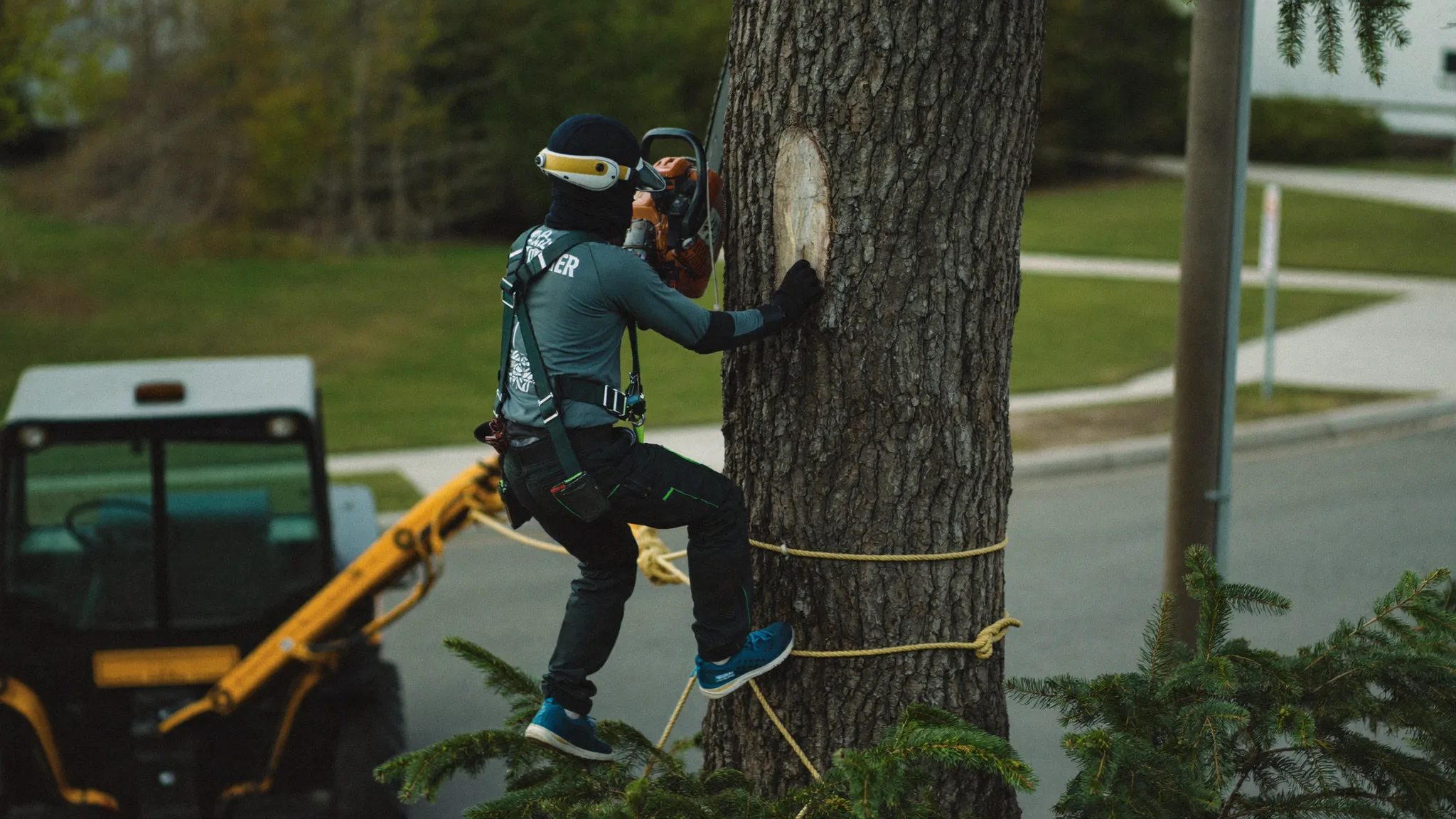
What insurance does a tree service need?
There's no one-size answer. The right mix depends on how you work, who you work for, and what your contracts ask for. These are the coverages a tree service typically looks at first:
General liability
Covers third-party property damage and injuries, including a dropped limb or felled trunk, with the $1,000,000 per-occurrence limit property managers typically request.
Workers' compensation
Climbing, chainsaws, and falling wood make tree work one of the more injury-prone trades, and once you have a crew, this handles their medical costs and lost wages.
Commercial auto
Trucks hauling chippers and crews between jobs are business vehicles, and personal auto policies often exclude business use.
Business property
Chainsaws, chippers, and climbing gear ride to every job, and this helps protect the equipment your crew depends on against theft and damage.
Coverage always depends on your specific situation. The fastest way to see what fits is to get a quote and review your options.
What does it protect against?
The risks that matter aren't abstract. They're the everyday accidents of the work. A few scenarios that turn into real claims:
A limb comes down on a roof
A wind-loaded branch you're removing swings wrong and punches through a client's roof, or takes out a section of gutter and siding on the way down. Overhead tree work turns a routine trim into a property damage claim in seconds.
A felled trunk lands on a car or fence
You misjudge the lean on a dead tree and it comes down across a driveway, crushing a parked car or flattening a neighbor's fence. Directional felling mistakes are among the costliest single-incident claims in tree work.
A climber or ground crew member is hurt
A climber's line slips, or a ground crew member is struck by a falling section nobody called out in time. Injuries in tree work run from sprains to falls from height, and once you have a crew, those claims land on workers comp.
A chipper or truck damages the property
A chipper backs into a client's mailbox, or a loaded truck ruts a lawn that was supposed to stay intact. Equipment moving around a property causes its own steady trickle of damage claims separate from the tree work itself.
Certificates of insurance
Property managers, municipalities, and homeowners' associations are the main sources of certificate requests for tree services: most want proof of general liability before a crew sets foot on the property, and larger municipal or utility-adjacent contracts often ask for a workers comp line too. Storm cleanup and insurance-referral work can also require a same-day certificate. Olli's general liability policies include instant certificates, so proof is ready when a job is.
New to certificates? Start with our guide to the certificate of insurance: what's on one, who asks for it, and how to provide yours.
Related trades
Other trades & home services professions face many of the same risks. See how the coverage compares: