
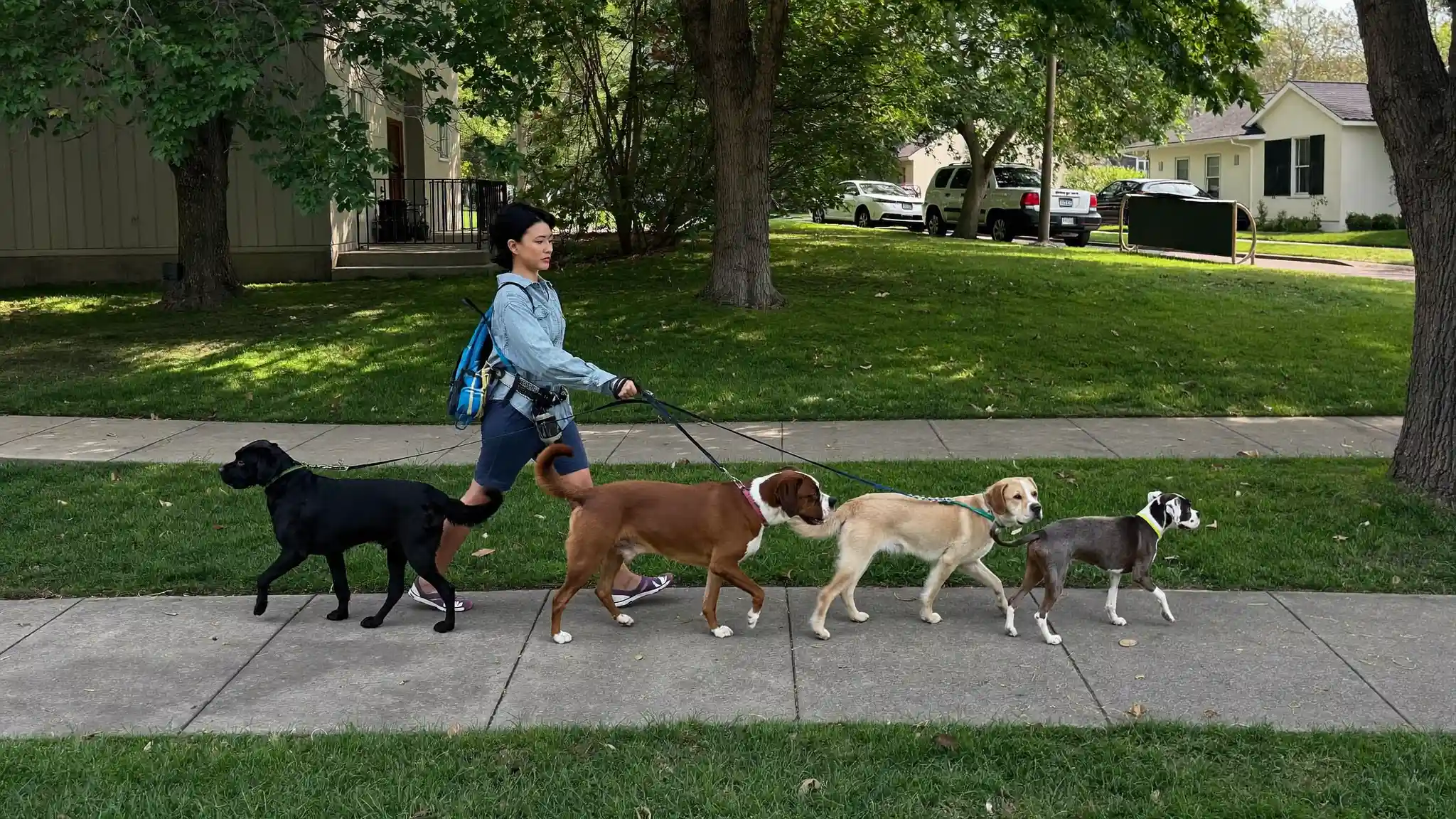
What insurance does a dog walker need?
There's no one-size answer. The right mix depends on how you work, who you work for, and what your contracts ask for. These are the coverages a dog walker typically looks at first:
General liability
Covers third-party injuries and property damage while dogs are in your care in public, like a bite or a leash incident, with the $1,000,000 per-occurrence limit clients and buildings typically request.
Coverage always depends on your specific situation. The fastest way to see what fits is to get a quote and review your options.
Many dog walkers also board pets or work inside clients' homes, which raises property and care-custody-control questions we cover in our guide to pet sitter & dog walker insurance.
What does it protect against?
The risks that matter aren't abstract. They're the everyday accidents of the work. A few scenarios that turn into real claims:
A dog off-lead or lunging injures a passerby
A dog you're walking slips its collar chasing a squirrel and knocks over a jogger on the path, or lunges at a cyclist and causes a fall. Because the dog was in your care in a public space, the injury becomes a claim against your business, not just the owner's.
Multiple dogs on leashes tangle a bystander
Walking a pack of four, the leashes cross as the dogs react to a passing scooter, wrapping around a stranger's legs and pulling them down. Group walks multiply the number of leashes that can go wrong at once, and the injury lands on whoever was holding them.
A dog bites another dog or a person at a crossing
Two dogs from different packs meet at a corner and a fight breaks out, or a startled dog snaps at a pedestrian who reached to pet it without asking. Bite claims in public carry medical bills and, often, animal control involvement.
A car incident during a street crossing
A dog bolts into traffic at an intersection, and a driver swerves to avoid it and hits a parked car, or the dog itself is struck. Incidents involving vehicles while a dog is in your care raise liability questions beyond a simple leash mishap.
Certificates of insurance
For a dog walker, proof-of-insurance requests come from clients before a first walk, since handing over a leash and a key or a lockbox code is an act of trust. Apartment buildings and HOAs come next: property managers who see the same walker in their hallways and elevators daily often require a COI naming the building. Dog-walking apps and pet-care collectives ask too. Olli's general liability policies include instant certificates, so a new client this week doesn't wait on paperwork.
New to certificates? Start with our guide to the certificate of insurance: what's on one, who asks for it, and how to provide yours.
Related trades
Other pet care professions face many of the same risks. See how the coverage compares: